Data center construction schedules don't leave room for surprises. A chiller yard that under-performs on the hottest day of the year, a hot aisle that runs 15°F above spec, or a ride-through that doesn't hold long enough for generators to pick up — these are problems that surface during commissioning, when the cost of fixing them is at its highest.
Cyclone Energy Group uses Cadence Reality Digital Twin to model failure modes months before construction begins. Below are the six analyses Cyclone Analysts run most often for data center developers, and the specific decisions each one informs.
Equipment yards are where site constraints and thermal performance collide. Screen walls, adjacent structures, tight lot lines, and prevailing wind all conspire to push hot discharge air back into condenser intakes. Even a few degrees of recirculation raises entering condenser temperature, derates chiller capacity, drives up compressor power, and — in the worst cases — trips units on high head pressure at exactly the ambient condition where you have the least margin.
Our team models the full yard: every chiller bank, generator, radiator, and exhaust stack, under multiple wind speeds and directions at design ambient. The output shows where plumes actually go, which units are ingesting their neighbors' discharge, and how much intake temperature elevation each one sees. That turns spacing, orientation, screen wall height, and stack location into engineering decisions backed by numbers instead of rules of thumb — and it typically pays for itself by avoiding either a capacity shortfall or an oversized, over-spaced yard you didn't need.

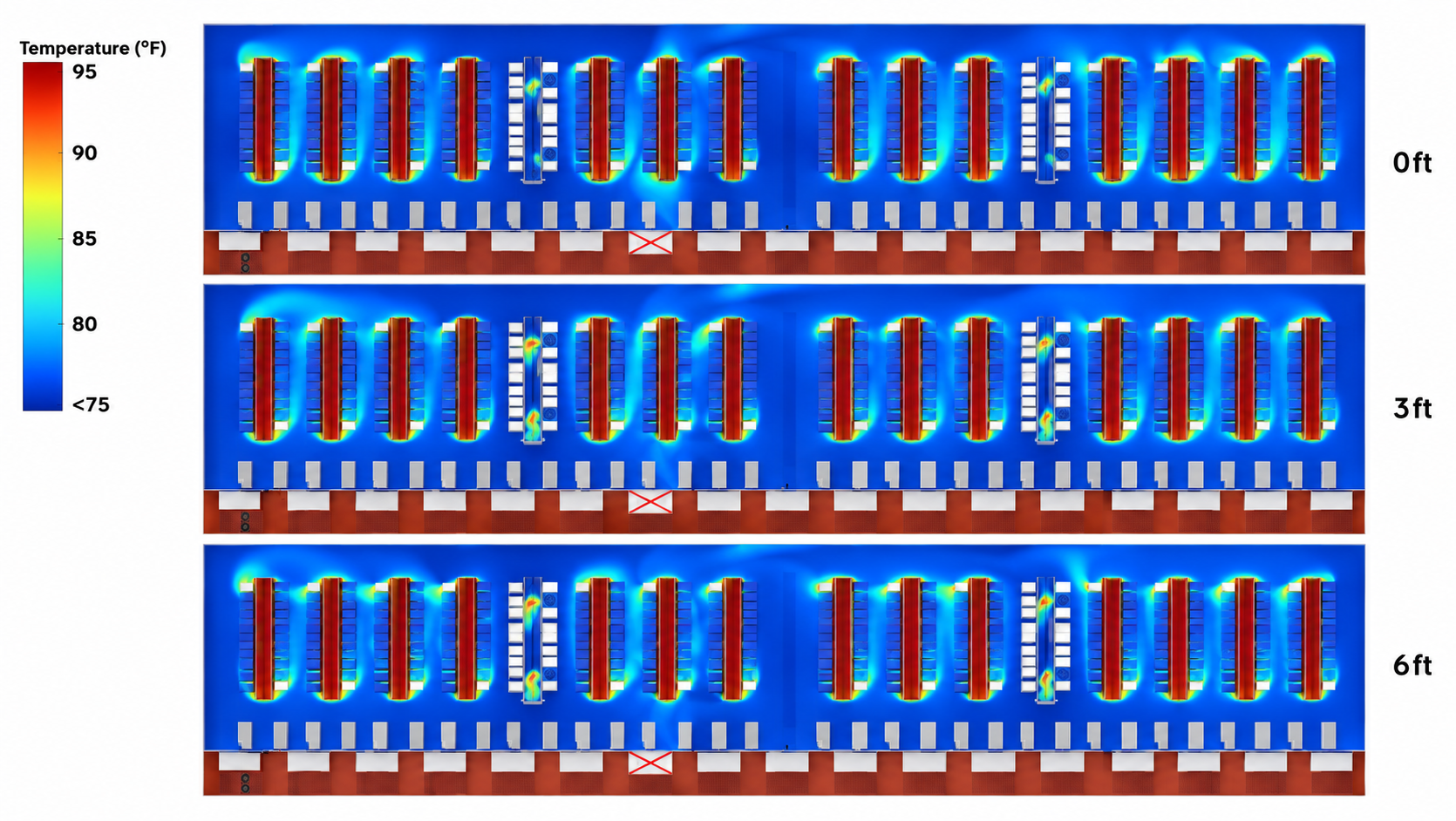
Containment works on paper. In the field, it leaks — through cable cutouts, missing blanking panels, gaps at the end of rows, door undercuts, and the space above partial-height containment. The result is bypass air that never does useful work and recirculation that pushes rack inlet temperatures outside the ASHRAE TC 9.9 allowable envelope, usually at the top of the rack where nobody is measuring.
Our Analysts model the data hall at multiple elevations to show exactly where cold air is short-circuiting and where hot air is folding back over the rack tops. That tells you whether your supply airflow, containment strategy, and Computer Room Air Handler (CRAH)/fan wall placement actually deliver uniform inlet temperatures across every rack position — and whether you can safely raise supply temperature to pick up more economizer hours without stranding capacity in the hot corners of the room.
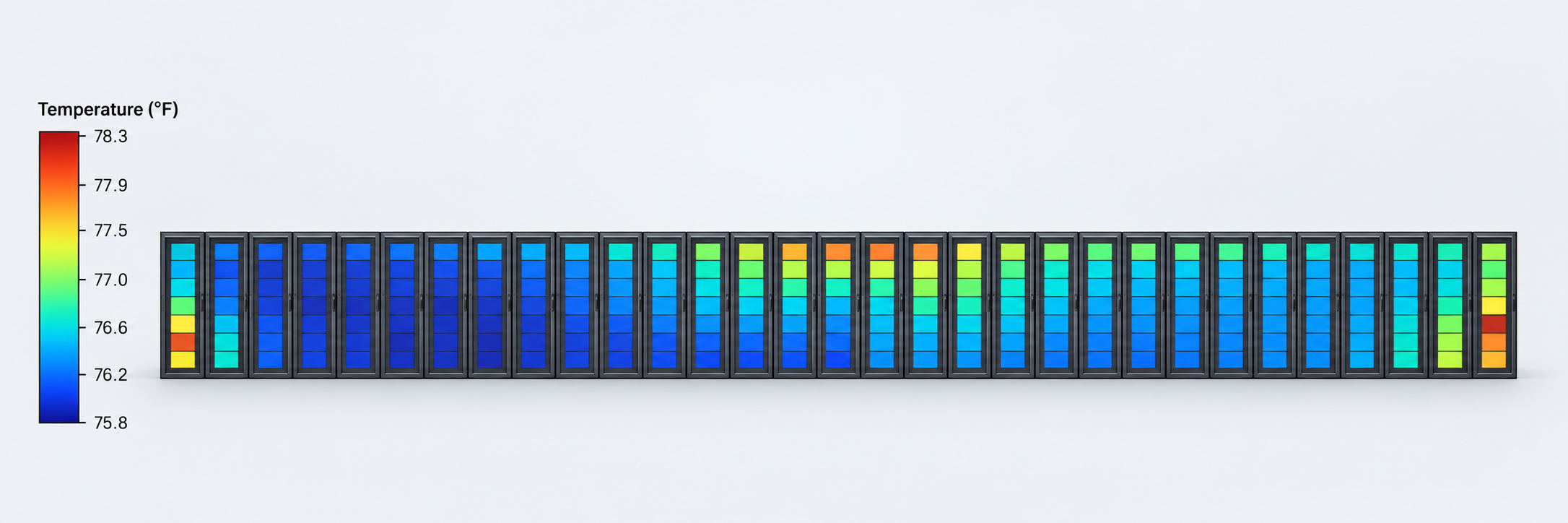
High-density liquid-cooled deployments shift most of the heat to water, but they don't eliminate the air side. Residual air load from power supplies, network gear, and non-liquid-cooled components still has to be managed, and the racks now sit next to Coolant Distribution Units (CDUs), manifolds, and piping that change the local airflow field. A rack that works fine in isolation can behave differently in a row.
We resolve conditions at the individual rack, showing inlet temperature uniformity across the full row and identifying any position that sits outside the acceptable band. For developers deploying AI and high-density computing, this is the analysis that confirms a hybrid air/liquid layout will actually hold its design inlet conditions before the first rack is energized.
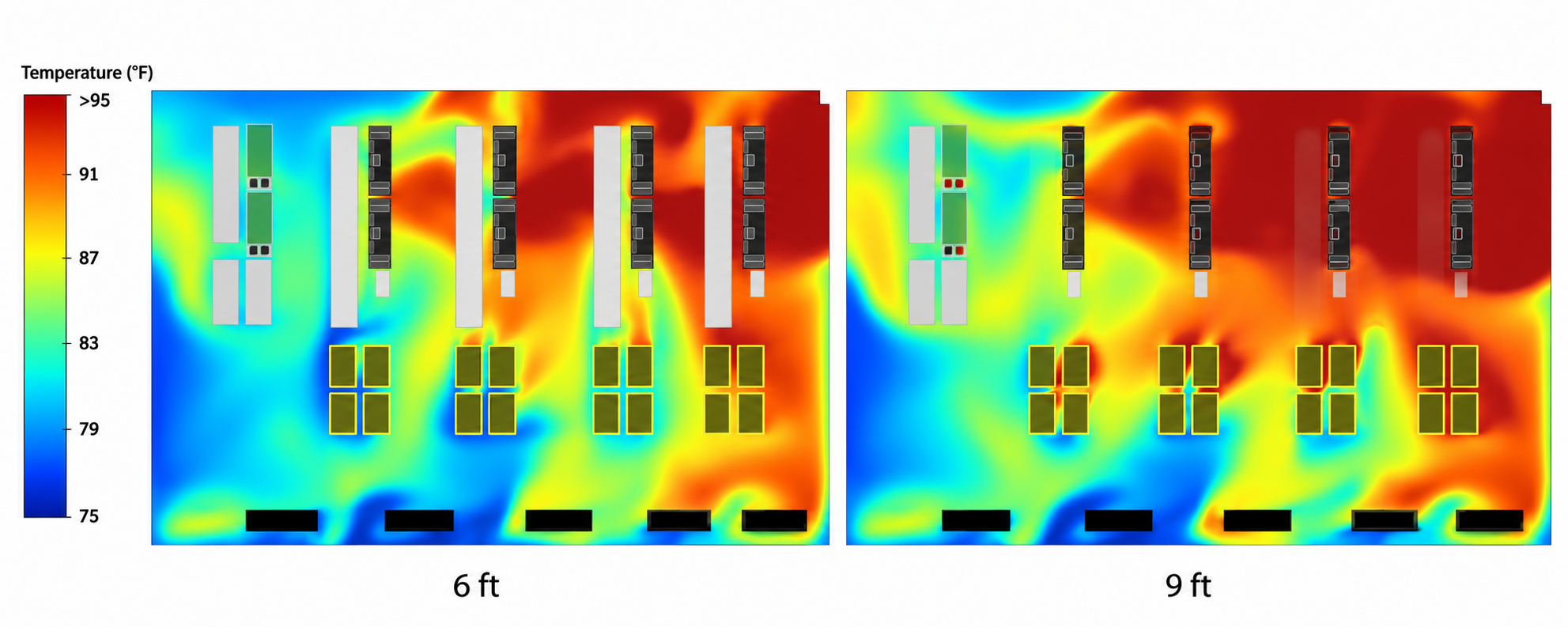
Redundancy is a claim until it's demonstrated. Losing a CRAH, a fan wall section, a chiller, or a single power path changes airflow distribution in ways that aren't intuitive — the remaining units don't simply pick up the load evenly, and the room can develop hot spots that didn't exist in the base case. Electrical rooms are especially unforgiving, since uninterruptible power supplies (UPS), switchgear, and transformer heat rejection is concentrated and the equipment has narrow ambient limits.
Our Analysts run the design at full "N" configuration and then systematically fail components to see what the room actually does. The result answers two questions that matter to both the owner and the tenant: does the redundancy scheme hold the space within spec under the failure cases in the Owners Project Requirements (OPR), and is any of that redundancy overbuilt? We've found both outcomes — designs that needed another unit, and designs where the CFD justified removing one.
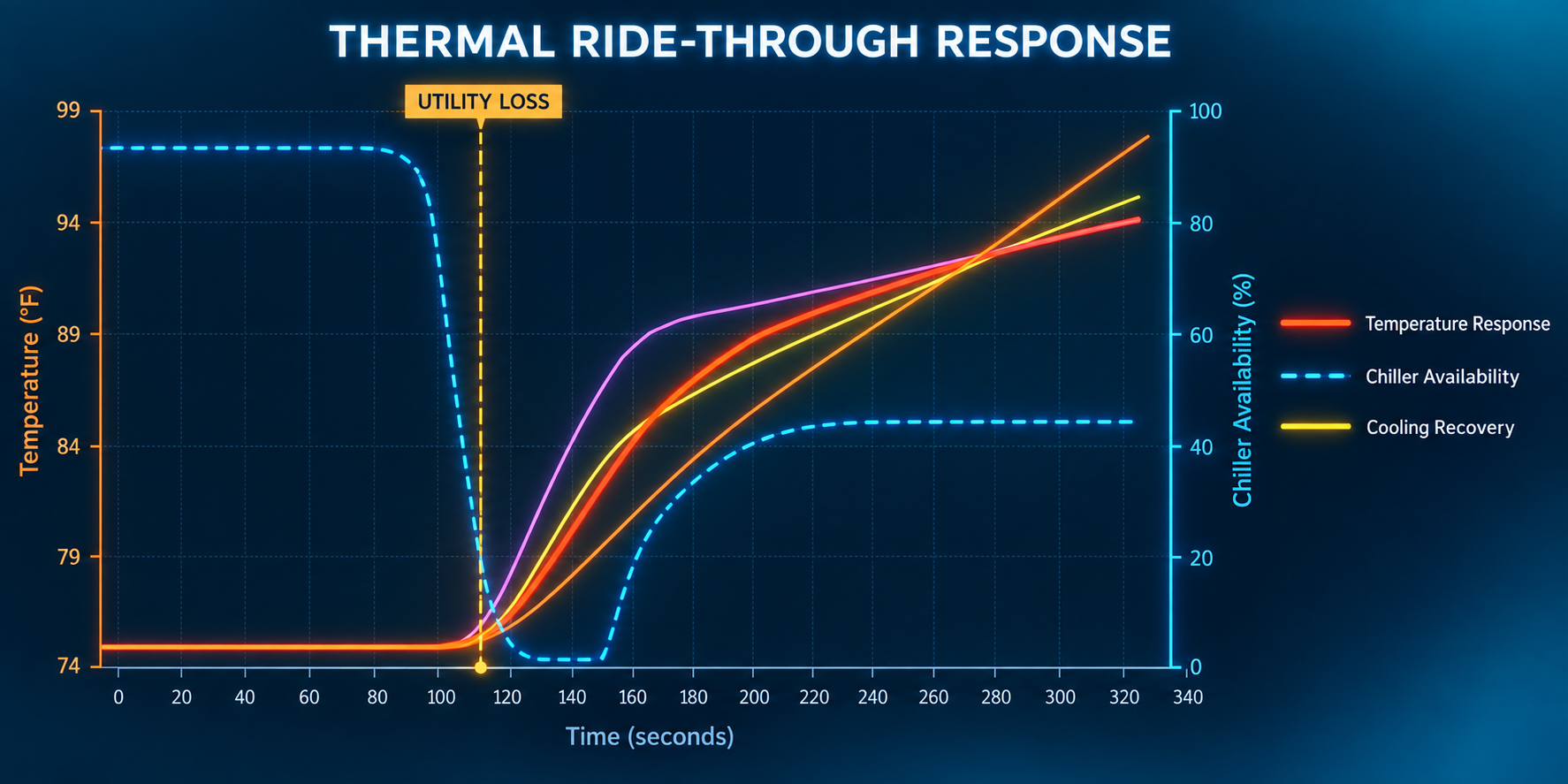
The most demanding thermal event in a data center is the 30 to 90 seconds between a utility loss and stable mechanical cooling on generator power. The IT load doesn't pause. Chilled water pumps and chillers restart on their own sequences. The question is whether the thermal capacitance in the system — chilled water volume, room air, rack mass — is enough to hold rack inlet temperatures below the trip threshold until cooling recovers.
Steady-state models can't answer this. Our team runs time-resolved transient simulations of the outage and restart sequence, producing the actual temperature-versus-time curve for the space and comparing it against equipment shutdown limits. That directly informs how much thermal storage you need, how fast the restart sequence has to be, and whether the ride-through strategy in your basis of design survives contact with physics.
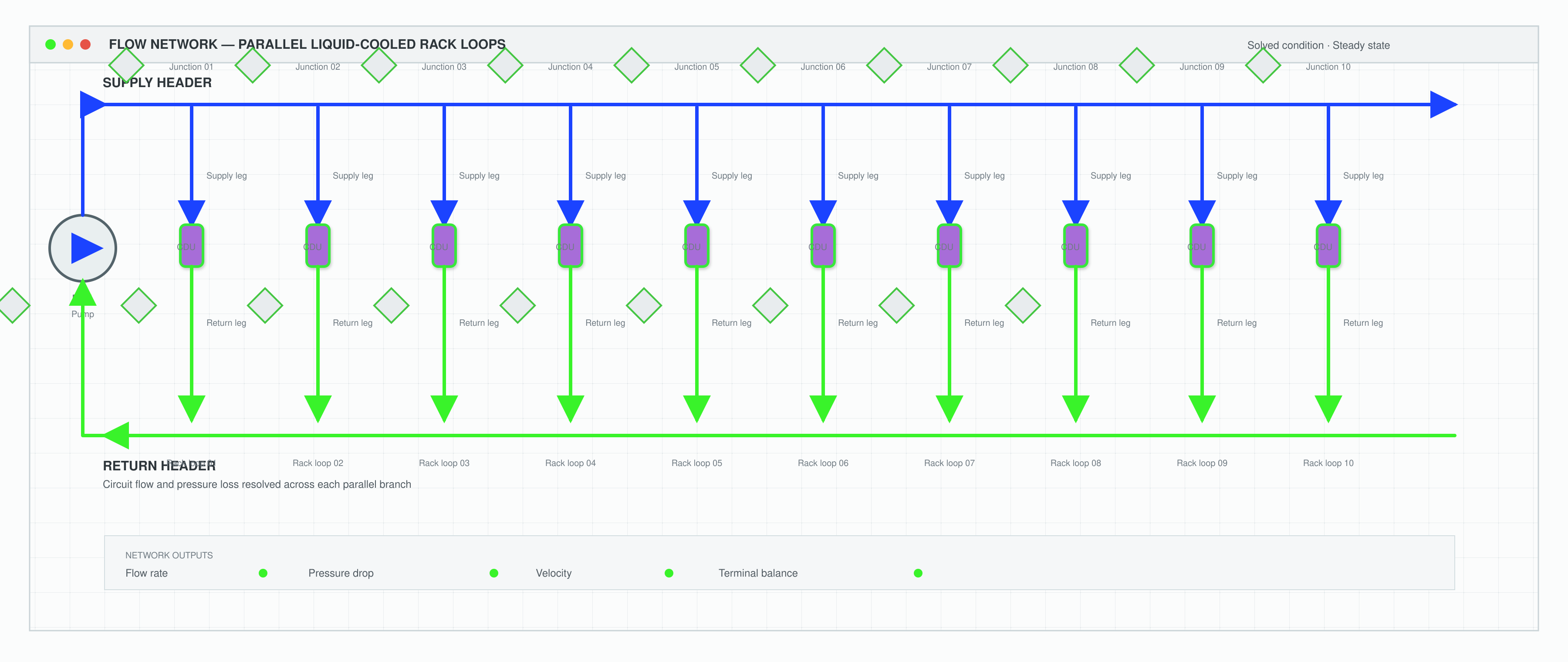
Hydronic distribution to cooling units and liquid-cooled racks is a balancing problem that gets harder as density goes up. Long manifolds feeding dozens of racks in parallel rarely distribute evenly on their own; the racks nearest the supply take more than their share, and the far end starves. Under-flow at a single CDU or cold plate loop shows up as a thermal problem that looks like a cooling failure but is actually a piping failure.
Our Analysts build a full flow network model of the piping system, resolving velocity, flow rate, and pressure drop segment by segment across every branch, junction, and terminal. That establishes the required pump head, validates pipe sizing, exposes where balancing valves are genuinely needed, and confirms that the last rack on the manifold gets the flow its heat load demands — before the system is installed and rebalancing means cutting into pipe.
Each of these analyses answers a question that will otherwise get answered during commissioning or, worse, during the first heat wave. Modeling them early converts open risks into design decisions you can defend to lenders, tenants, and AHJs — and often finds capital savings in redundancy or yard footprint that more than cover the analysis.
Cyclone's simulation team supports data center projects from concept through commissioning support. If you have a site with tight constraints, aggressive density targets, or a redundancy scheme that needs to be proven rather than asserted, we'd like to look at it.
815 S Wabash Ave
Chicago, IL 60605
615 S. College Street, 10th Floor
Charlotte, NC 28202